Wednesday, 20 June 2012

Myitkyina to Bhamo – Much Against Everyone’s Advice

An San Suu Kyi
At a restaurant perched above the broad Irrawaddy river I gazed lazily through a picket of empty tea cups and Mandalay beer bottles. Flies buzzed over the remains of lunch – rice with a gristly but tasty chicken curry. Max dozed in his chair, bare feet resting on a plastic stool, a German novel forgotten on his stomach. We had been drinking in what he called the Bavarian way, one beer before lunch and one after, and in the steamy tropical heat it had a pleasantly soporific effect. Below us a girl dressed in a sarong beat clothes on a smooth rock and laid them out neatly on the pebbly bank where they sat in the sun like a huge patchwork quilt. Beyond the slow, brown river rice paddies carpeted a wide valley floor in front of distant mountains that piled higher until I couldn’t tell where they ended and the sky began. We were as far north as we could get in Burma. Farther on the dirt highway dissolved into high footpaths and the river split into clear, fast streams of snow melt. Somewhere over the horizon the Indian and Chinese borders snaked through 4000m ice mountains. It was the end of the road.
            I had met Max on my first day in Burma nearly three weeks before but had not seen him again until we almost literally bumped into each other at our grimy little hotel. He had looked pale and told me of his horror train ride from Mandalay during which he had been struck down with stomach problems while crammed into a wooden seat for thirty hours. He had bounced back manfully the following day and we wandered Myitkyina’s markets and dirty, tree-lined streets for two days while he taught me to swear in German and we tried to determine whether our grandfathers had shot at each other during the war.
            The town was abuzz with talk of the upcoming visit of An San Suu Kyi. Hotels and family homes filled and then overflowed with the tide of people coming in from outlying towns and villages. Many of them had walked for days and were easy to spot with their dirty hands and traditional Kachin clothing. When they saw us, kids hid in their mother’s sarongs and men muttered to each other, called out greetings or just stared.
            An San Suu Kyi is a national hero and on the day of the rally Max and I were swallowed in a honking, singing jam of people and cars as we made our way to the overgrown sporting field where she was to speak. We were joined by a Japanese girl who had gained my undying love by a) having the fantastic name of Misaki Nakayama and b) offering me Indian chapatti bread on our first meeting.

The world's happiest traffic jam.
            The Australian government travel advisory warns against both traveling to this part of Burma and attending any pro-democracy events. But then according to the government advisory any country besides New Zealand and Switzerland is a seething den of murderers and scary foreign types. I had long ago taken as my motto an unusual mash of two of last century’s greatest thinkers – Sir Winston Churchill and Austin Powers.
“We have nothing to fear but fear itself, and carny folk,” I muttered to myself as the crowd sucked us along. Again my insane pseudo mantra was proved correct, it was a perfect carnival atmosphere – like AFL grand final day in Melbourne, but without the Collingwood supporters. And not a carny in sight.
            Outside the sports field traffic was stopped and we edged between tooting trucks overloaded with singing, chanting people waving the red flag of the National League for Democracy, An San Suu Kyi’s once-banned political party. A dark 4x4 with black windows pushed it’s way silently through the chaos and we watched as it clipped the back wheel of a motorcycle that hadn’t gotten out of the way fast enough. The rider and the bike fell onto the road but the 4x4 didn’t stop or even slow as it disappeared into the throng.
            “Government,” a man said to me with a tight smile. The rider got up and a couple of guys helped her with the bike. No one even looked at the government vehicle.
            By the time we had squeezed through the gate the woman they simply call ‘the lady’ had already begun speaking. I guessed the crowd to be about 20,000. I stood hard against the back fence and peered through a thicket of red flags. An San Suu Kyi stood on a raised dais flanked by supporters. Dressed symbolically in ornate Kachin dress, she looked older than I expected but still slim and ramrod straight. Every few minutes the crowd roared their approval and ten thousand red flags flicked back and forth. Often she was interrupted by a question from the audience to which she listened carefully before replying, usually to gales of laughter. I hadn’t the faintest idea what she said but she was clearly a superb speaker and adored – even worshipped – by the crowd. I listened for half an hour and then wandered through the crowd. The occasional English speaker would ask me where I was from and if I was a journalist, to which I would squeak an alarmed, “no!” I got chatting to a well-dressed man with perfect English which he kept apologizing for. He told me that only a couple of years ago a rally like this would have been unthinkable. As I was leaving he grabbed my elbow, darted his eyes from side to side and whispered, “Be careful.” Then he let me go and began laughing. “Ha! Got you.” Ha bloody ha.

The crowd.

            Behind the crowd, half hidden in a stand of trees I found three vehicles full of riot police. One of the men looked at my camera and waved me away. The rest were half asleep.
            After the rally we sat in a tea shop and watched the crowd leave, still waving their flags, singing and honking. A pick-up crammed full of men pointed to my camera and posed for a photo, laughing.
            On the walk back I thought how refreshing it was to see people so passionate about the future of their country. It felt like a population that could finally taste the end of decades of repression and violence. And that, my new friends and I decided, was a pretty good reason for a beer.
            The following day we all boarded an Air Myanmar flight south to Bhamo – another no-no according to the Aussie government due to the supreme dodgyness of their fleet of old prop planes. But the road south was in the control of one or another of Burma’s rebel armies and the ferry we had hoped to catch downstream could not navigate the shallow, silted river at this time of year. As it turned out the plane was a boringly modern jet rather than the WWII military surplus clunker I had secretly hoped for. The only pulse-quickening moment on the 17 minute flight was the deep thud of an overhead locker door shooting open soon after take off. Safely in Bhamo we found a hotel and went in search of the ferry ticket office.


Saturday, 19 May 2012

Myitkyina


The Irrawaddy river at Myitkyina, northern Burma.
West of Mandalay the ancient train crawled over the wide Irrawaddy river – slow, brown and dry-season low – and rolled north. As the brick and dirt towns gave way to dry fields the insane jumping and pitching which had been throwing me off my seat for an hour calmed to a more gentle bounce and clatter. I slumped against the window and watched the sun fall through the smoke haze. Occasionally the line crossed a track where a farmer sat shielding his face from the dust in an open-cabined truck, exposed single-cylinder engine popping smoke rings and looking more at home on a generator than a road vehicle.
Soe Soe, the chubby man with whom I had shared a beer earlier, had returned to his bunk and appeared asleep. Across from me was Soe Soe’s mother. Neatly dressed she sat straight-backed, hands braced beside her knees. The narrow floor between the two bottom bunks was packed with cardboard boxes which toppled over every few minutes. When I helped her right them she smiled her thanks and returned to staring out of the window. The last passenger in our four-bunk compartment was also in his sixties and wore a suit. He carried only a slim briefcase and, apart from politely refusing to join us for a beer, had remained silent. The smoke from his expensive imported cigarettes curled through the compartment and I was reminded that I was travelling first class. The floor was torn and my window was jammed half open. Every metal surface was rusty and dented. Everything that could be broken was – the small table under the window canted sharply and the door to the cupboard underneath swung between its warped jamb and the stack of boxes. Tiny paint-flakes from the peeling wall swirled in the breeze and every surface was stained by decades of diesel smoke. It was filthy, but at least you got a bed and some personal space – a level of comfort that most Burmese couldn’t afford, judging from the straight-backed wooden seats I had glimpsed in the crowded lower class cars.
             After an hour Soe Soe roused himself and sat beside his mother spitting red beetel nut juice out of the window. I went to find the bathroom and buy us more beer. I staggered up the corridor pin-balling off the walls and found a group of guys sitting cross-legged outside the toilet surrounded by baskets of snacks, cigarettes and drinks. It was so crowded that two of them had to move so I could open the toilet door. Inside was a hole in the floor where the sit-toilet the British had installed so many decades ago had been ripped out by locals accustomed to squatties. The sink had also been broken off and the walls were so caked in filth that their original colour could only be guessed at. At the end of the carriage a man stood on the steps below the carriage door, gravel and weeds flashing below him. He was braced against the dented handrails pissing – a much more sensible option. As I leant out of the window I could see our train’s silhouette flit through the dry grass. In the shadow a figure walked carefully along the roof of the next carriage. I watched amazed – I could barely keep my footing holding onto the walls – as he handed a basket down to one of the drink-sellers and slithered between the carriages to join his mates next to the toilet. What seemed to me a suicidal piece of derring-do reminiscent of Indiana Jones was just part of their daily routine – the only way of getting to upper class where people could afford to buy their Coca-Cola and beer.
            Back on my bunk I drank beer and watched the sun set. The compartment filled with the smell of food as Soe Soe’s mother busied herself with a stack of interlocking stainless steel pots containing the Burmese standard meal of steamed rice, light curry and green vegetables. The businessman stopped smoking long enough to produce an al-foiled pork cutlet and a Tupperware tub full of soup. It was real bachelor fare and Soe Soe’s mother took one look at it and clicked her tongue before turning her attention to my sorry ration-bag of marshmallow cookies and bananas. She obviously didn’t consider either of these adequate and divided the available food into four portions while the businessman and I looked sheepishly at each other. Soon we had a feast of rice, pork curry and soup followed by marshmallow cookies.
            Late at night the train stopped for a long time and I lay on my bunk in the warm night looking out on a landscape devoid of artificial light and counted stars until I fell asleep. I woke sometime later when an especially rough section of track drove my head into the wall and spent a sleepless night listening to my new friends’ snores. In true Burmese fashion, my compartment mates were awake and bright-eyed soon after dawn while I curled in my sleeping bag against the morning chill. We were further north and the air was cool and damp. Outside the dirt fields had turned into damp, green bush and vines grew so thick on a telephone line that ran beside the train track that the line itself was invisible for miles at a time and the steel poles were hunched under the weight. The train crawled up an incline and over a narrow stream. On each end of the bridge a bored kid in uniform sat behind a heavy machine gun mounted above a sandbagged fox hole. We began passing these gun emplacements regularly – always only one soldier and always too-young looking. Soe Soe told me that we were now in Kachin state and the government was nervous about the rebel army targeting the railway. I left the compartment to pee out the door and brush my teeth with a bottle of water and had to step over a stack of olive green steel chests that looked like WWII military surplus. Sitting on the chests smoking a cigarette was a barefoot teen cradling a battered AK-47. He wore the same uniform as the soldiers beside the tracks and shot me a friendly grin as I edged past the business end of his rifle.
            Mid-morning we pulled into a smoke-stained little station shadowed by gnarled, broad-leafed trees and surrounded by stacks of enormous logs, four feet across, cut to length and dressed ready for transportation. We hadn’t passed any trees even approaching that size and I wondered where they had come from. The businessman got off the train, stepping lightly off the last piss-slicked step and two feet down into the trash, incongruous with his suit and slim case as he walked down the tracks.
            We arrived at Myitkyina station in the afternoon. Soe Soe wanted to meet up later and take me on a guided tour so we arranged a time and I shouldered my bags through the bustling regional capital and found a grimy hotel crawling with backpackers in a backstreet next to a motorbike repair shop.
            I had a cold water shower under a fizzing light bulb and met Soe Soe near the station. After a sweet milky tea he ushered me proudly into his jeep. It was covered in stickers reading ‘number one race’ and ‘mud sport’. The bonnet had a Toyota badge and the dashboard said Mitsubishi but it was really a Burmese-made copy of a Jeep soft top, rear wheel drive only and powered by a smoky old diesel. After a quick tour of town – dirty streets, shops selling Chinese crap and a vegetable market so crowded we couldn’t drive past it – he said he wanted to show me something.
            “Do you know Aung San Suu Kyi ?” He asked as we drove south alongside the river. I had seen her photo next to that of her assassinated father on the wall of every house and shop I had been into and I knew that they were regarded as national heroes. I also knew that Aung San Suu Kyi had been kept under house arrest off and on for most of my life by what was always described in the Australian media as the ‘ruling junta’. A few months earlier she had been released again and Soe Soe told me that the Nobel peace prize laureate was due to speak in Myitkyina in two days time.
            “My family is helping her. I will show you.”
            At an overgrown sports field by the river a group of men decorated a raised platform and speaking dias with posters of the National League for Democracy, Aung San Suu Kyi’s political party. We pulled up and Soe Soe introduced me to his father. He told me in halting English with a hint of a posh accent that they were expecting up to 40,000 people to hear her speak.
            “Some people will travel very far,” he stumbled with a laugh, “I am sorry, my English was very good when I was young but I have forgotten so much.” I guessed he was in his 70s – old enough to remember British rule. As we were leaving a half dozen distinguished older gentlemen in red NLD t-shirts shook my hand solemnly. Soe Soe’s father held my hand in both of his and told me I was welcome to come to the demonstration.
            The light faded and Soe Soe suggested some food and a beer – a man after my own heart. We swung by his house where his mother greeted me like an old friend and produced a jar of palm sugar candy and iced tea. By now I knew the futility of refusing food from this woman and sat snacking as Soe Soe showed me off to his sister, brother-in-law and niece. The extended family shared one of the nicer houses in town and we sat in the courtyard as his six year old niece practiced her English on me.
            At a restaurant in town we ate freshly grilled kebabs. Soe Soe recommended the pig. The skin and offal were ok but when I reached an ear I told him that I was not keen on sensory organs. He scooped it off my plate and ate it with much exaggerated lip smacking. I made a mental note to bring Vegemite next time – two can play at the gross-out-the-foreigner-with-acquired-tastes game. I struggled to keep up with Soe Soe’s cracking drinking pace and after four long-necks of Mandalay he became morose.
            “Do you want to see my family?” He showed me a photo of a pretty woman and a small boy. “He is six now, this is old. They live in Mawlamyine where my wife works. There are no jobs here. I see them twice a year, at Burmese new year and my son’s birthday. It is two days on the train but it’s too expensive to fly.”
            I had no idea what to say.
            “Life is a struggle.” Soe Soe said and drained his beer.
            I went to the bathroom and by the time I got back he had paid the bill and seemed happy again. He wouldn’t take my money.
            “It’s ok. Come.” He pointed to a handful of pretty girls lingering outside a beauty salon. “We will have a…” He searched for the word and massaged my head. “A wash, yes! A head wash.”
            We lay side by side on vinyl massage tables and had the most thorough hairwash I’ve ever had follow by a soapy shoulder massage. It was so relaxing I dozed off and only just woke in time to dash downstairs and stop Soe Soe paying. He dropped me at my hotel and we agreed to meet for breakfast at 7.30. I waited in front of my hotel until 9.00 but he never came and I never saw him again. I’ve since learned that the government likes to knock on the doors of NLD supporters late at night and take them into custody to disrupt demonstrations like the one planned by his father. I really hope that Soe Soe just had a hangover that morning. I decided to hang around until the rally but I didn’t see him or his family.

Soe Soe.

Thursday, 10 May 2012

Mandalay to Myitkyina – Trainpouline


Mandalay. The end of the road - the road east anyway.
With a couple of weeks left on my Burmese visa and my hopes of crossing into China dashed, I sat and studied a map of Burma over a beer. I had a list of permitted transport routes and restricted provinces and I saw that my options were limited. By area at least, the vast majority of the country was either off-limits entirely or required permits. Because of these restrictions and the slowness of travel, the banana pancake trail – the route taken by backpackers – is particularly deeply grooved in Burma. From Rangoon to Inle lake via a trek from Kalaw with the obligatory stop in Bagan, then to Mandalay and back to Rangoon – around and around it goes. This is a perfectly reasonable thing to do, but with recent lifting of travel warnings by several western nations, this tourist season was booming and the number of cheap beds in hotels licensed to take foreigners was somewhat less then the number of foreigners wanting cheap hotel beds. Anywhere recommended or even mentioned in a guide book was booked out weeks in advance. All I’ll say about the kind of person who sits at home with an itinerary and a Lonely Planet guide booking hotels over the phone in Burma for every night of their stay is that I wouldn’t want be stuck next to them on a bus.
            At this point I’d like to introduce a new and probably controversial regular feature on this blog called ‘Things I Think Should Definitely be Illegal and if you Don’t Agree You’re a Massive Nonce’. Unwieldy title I know but bear with me. The inaugural TITSDBIAIFYDAYAMN is reservations. I support a first come first serve policy in all things, including but not limited to hotels, restaurants, sporting events and all forms of transport. This is, in fairness, mostly because I can’t work reservations. The last time I tried to book a flight online the website emptied my bank account and emailed me a ferry ticket to Greenland, and whenever I book a hotel it’s in a part of town that taxi drivers have either never head of or are too scared to enter. How the hell does one go about booking a youth hostel in Burma from Australia or the UK anyway? I had never considered it a possibility.
            Anyway I was sick of having to choose between overpriced Chinese business hotels and $5 hovels – and nowhere does hovels like Burma – so, as nice as a boat trip across Inle Lake to see a traditional Shan minority make-money-off-white-devil dance or whatever, I decided to give it a miss.
            North of Mandalay towards where the Irrawaddy river is born in the Himalayan foothills near the Chinese border was a town marked in my map as Myitkyina. It is the capital of Kachin state where an uneasy peace reigned between the Burmese army and the rebel Kachin army after a recent bloody uprising. The trip there was still listed in my permitted transport routes and when I looked up my old Lonely Planet, it whined drearily about the slow, dirty and dangerous train ride. I thought that ought to thin the ranks of tourists so I bought a sleeper ticket for the following day.
            I was hoping for a British-era relic but Mandalay’s train station had been recently rebuilt and now sported an odd façade that brought to mind an outsized Swiss chalet in front of two levels of boxy concrete waiting rooms and ticket offices. It was a shame because the train that arrived two hours late belonged in a Victorian brick-and-steel station full of hissing steam and men in splendid hats. The loco was a square modern diesel (anything built after 1970 is modern in Burma) but the carriages were survivors of the original 1920s rolling stock – so many layers of cream paint had been applied over 90 years that every edge appeared rounded and organic and the stern English lettering marking lower, upper and sleeper cars had been carefully retouched. Before the train had stopped people clutching bundles and bags jogged to the doorless entrances, jostling for a seat. The trip would take somewhere between 20 and 30 hours – no one seemed quite sure. Foreigners in Burma pay anywhere between double and 10 times the local price but, embracing my English heritage, I had lashed out for the most expensive ticket, an upper class sleeper – must keep up appearances, old boy. My four-bunk compartment was already occupied by three people.
            “Hello. How much was your ticket?” said a man laying on the opposite top bunk. He was in his thirties, chubby with a baby face and rotten teeth stained red with beetel nut.
            “45 dollars.” I said. All government-run transport is paid in dollars by foreigners.
            “How much kyat?” He frowned.
            “36,000.”
            He hung his head off the edge of his bunk to translate for his mother in the bunk below. “We pay only 10,000 and the people in lower class,” he waved vaguely towards the back of the train, “they pay only 2,000. Where are you from?”
            “Australia.”
            “Australia! Kangaroo, very good. Do you like beer?” I nodded. “Good. We will have a beer.” He vaulted from his bunk, poked his head out of the compartment and made the kissing noise used in Burma to summon a waiter – think of the noise you might make to get the attention of a cat, only louder – and yelled something down the corridor. A teenager carrying a dirty basket full of scratched beer and cola cans stopped outside our compartment. My new friend bought four cans of Myanmar beer and handed me two.
            “We must drink now, before the train goes.”
            “Why?” I asked.
            “You will see.” He grinned, happy to have a drinking partner, and threw his empty can out the window. I hadn’t had a sip yet.
            Soon the train lurched and clanked into motion and I saw why he was in such a hurry. As we picked up speed past a carpet of plastic bags, the train began to bounce and sway. We squeezed between diesel-stained houses built within feet of the tracks – I could easily have touched them – at a maybe 30kph. I sat perched on my bunk next to the window and was forced to press against the underside of the top bunk with my palm to avoid hitting my head every time I became airborne. During an especially spirited period of bouncing I waited for us to de-rail as my free hand snaked and swayed in front of me in a gallant attempt to keep my beer upright. The bouncing came in waves like a succession of earthquakes and I found that I could predict the most spine-compacting periods of seismic activity by listening to the metallic slam of successive carriage couplings hitting their limits as the train moved over a particularly undulating section of line. By listening carefully and letting my elbow go slack I could occasionally get a mouthful of beer which helped me relax into the rhythm. Only another day of this, I thought.

Somewhere, Burma.

Tuesday, 8 May 2012

Bagan to Mandalay – Smoke Me a Kipling

Burmese trucks - I just want one.
There’s a famous poem by Rudyard Kipling called ‘The Road to Mandalay’ or some such thing. Now as we all know, poems that aren’t limericks are far too awful to consider actually reading so I haven’t read that one, but as my bus swayed and jolted down the actual road to Mandalay I wondered how a poem about being crushed against a window and sandblasted with dust while dying for a pee ever got so popular. I later learned that the man named after the area behind a sawmill (“Where do the offcuts go, boss?” “Just throw ‘em in the rudyard.”) had never actually been to Mandalay. This, in limerick form, is what he would have written if he had.
           
There once was a road to Mandalay
            It was shit

Now I know that’s not technically speaking a limerick, but it captures the essence of my experience. The bus, in true Burmese fashion, was hopelessly overloaded with three people to every double seat and the aisle full of plastic stools that bounced and slid on cracked linoleum as we slammed through potholes and swerved around ox carts. We stopped, or at least slowed slightly, every few miles to pick up passengers from the ends of dirt roads or ten-hut villages choked with dust. All day we passed flat, dry fields. As we crawled through towns girls rattled stones in dented pots, begging for money from the passing motorists. As our shadow flickered through the grass, I could see the silhouettes of the handful of guys who rode on the roof, laying on sacks and luggage. After a rest stop I began climbing onto the roof but the driver pulled me away, saying it was dangerous. I tried to explain that I just wanted slap the guy who’s red beetel-nut spit kept flying past, and sometimes into, my window and then return to my seat but it was a hard concept to mime and anyway it was a lie – I’ve always wanted to ride on the roof of a bus, and it looked infinitely more comfortable than my seat. I past the next four hours in my sun-nuked seat with no food or water and my sunscreen safely packed away and lashed to the roof.
Mandalay’s bus station is actually an enormous dirt parking lot filled with hundreds of buses. Ticket sellers sit behind sandwich boards advertising prices and departure times. They are all private companies and popular routes are often serviced by a dozen buses, the prices depending on their speed and state of disrepair. Air conditioned coaches sat beside windowless 1950s school buses without seatbacks and between them all a near-gridlock of honking taxis and reversing buses. As we rolled to a halt in long grass next to a chain link fence I disembarked through a mob of taxi drivers, swooning like a Victorian lady-in-waiting. I let an older guy lure me onto his motorbike taxi with the promise of a drink. I chugged a litre of water, letting it dribble down my neck as though I was advertising a rehydrating sports beverage (Why do they do that, by the way? I watch those adverts and think, “well, I’ll certainly avoid that product, it looks incredibly difficult to drink.”) before whirring towards Mandalay.
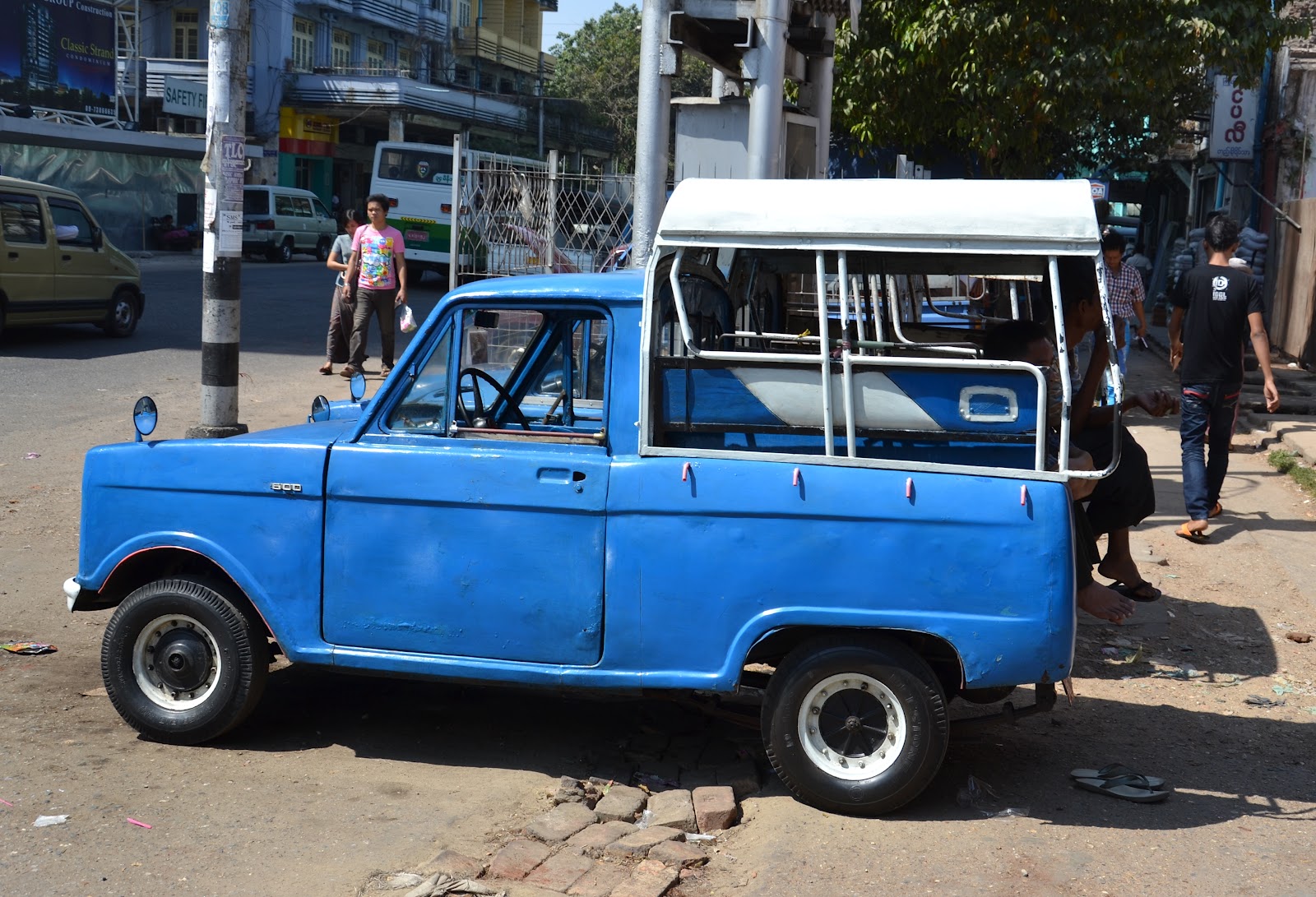
The city was a hot square grid made of concrete and dirt set against a huge palace compound fenced with a moat and high walls. Beyond the palace rose Mandalay hill – its gold-roofed pagodas just visible through the smoke haze. Mortorbikes were banned in Rangoon but Mandalay was choked with scooters going the wrong way and blocking intersections while tiny blue Mazda utilities the size of pedal cars squatted under a load of crouching passengers. I had, my driver told me, hit afternoon peak hour. The first three hotels I tried were full but eventually I found a room up seven flights of stairs. As I fumbled for my passport at the reception desk, a group of businessmen elbowed me out of the way and started jabbering at the clerk, all talking at once. He gave them a key and they sat down on the lobby couches, ashing their cigarettes on the carpet and talking so loudly I could hardly hear my room number. Soon they left.
“I’m sorry about those men, they are Chinese,” said the clerk screwing up his nose and glaring at their retreating backs. “They’re so rude.”
Mandalay is only a day’s drive from the Chinese border and the clerk told me that trucks bring a stream of cheap electrical goods and plastic tat into Burma through the city.
“They get rich but we get nothing.” I felt like pointing out that he was employed by a hotel full of Chinese businessmen but he had mentioned something about a hot shower and I was excited. It was my first hot shower in Burma and by the time I had scrubbed myself a few shades lighter it was dark and I was starving. I found a restaurant – all Chinese food, I noticed – and sat planning my next move. I had hoped to go from Mandalay through the border town of Lashio and into Kunming in China, the same road that the Chinese trucks were plying, but with fighting near the border the whole area was off-limits. I rather snidely considered disguising myself as an endangered species or an old growth forest – a sure way to get into China – but of course I would be immediately killed. Or mulched.
The next day I got talking to a Chinese backpacker – the first I had met – who was drunk at lunchtime and looking for company. He was on his way back home to Xi’an in central China by land. I told him that I wanted to do the same and he became my instant best friend.
“Then we will go together!” He exclaimed, toasting our journey.
“But I can’t go cross the border. I think I must fly.” I said.
“No, no. I will check for you.” He fished in his pocket for a mobile phone and made a call to the Chinese border post.
“No good. He says that only Chinese people can cross. If you try you go to jail. Or maybe Burmese people shoot you,” he leaned closer, “They’re crazy, you know.”
It looked like I was flying.

Best. Thing. Ever.

Thursday, 3 May 2012

Bagan – Angering the Gods in Tourist Town

Bagan.
My first impressions of the Burmese tourist Mecca of Bagan were coloured by the dreamworld of a 5am bus stop. Two drunks stood under a streetlight exchanging wild haymakers that connected with sharp slaps. Somewhere in the distance a tinny loudspeaker broadcast the Buddhist morning prayer, a monotonous monotone chant over discordant music. Three young monks pedalled past and creaked into the mist. The brawlers chased each other away but their yells echoed out of the darkness for a long time as I warmed my hands on an instant coffee and watched a yawning man hitch his blinkered horse to a cart, ready for the morning rush of tourists wanting to watch the sunrise over Bagan’s ancient temples. I yawned in sympathy and my mouth felt gritty after 24 hours on a succession of dusty buses so overloaded that people sat in the aisles on plastic stools and men rode on the roof and spat blood-red beetel nut juice past the open windows.
            As the dawn tinged the mist orange, a trishaw driver offered to take me to a cheap hotel. The place was old and dirty but I didn’t care as I flopped onto the bed and passed out.
            At midday it was a different place – hot under a clear sky and crawling with tourists. I walked past souvenir stands and hotels to restaurant row where I wolfed my first meal in 36 hours. Desperate to stretch my aching back, I spent the afternoon walking amongst the crumbling ruins of ancient temples. No longer haunted and foreboding as they had seemed from my bus window, they dot the plain at random and goats graze around them while their herders sit on thousand year old steps. There are more than 2,000 within a few square miles and although a steady stream of middle-aged tourists in horse carts and backpackers on wobbly bicycles passed me, there were still more temples than visitors and I spent a happy few hours humming the Indiana Jones theme while crawling through dark passages and clambering over crumbling roofs. I wished I had a large whip and a sexy assistant, although what I’d do with them is no business of yours.

Early morning ballooning over ancient temples.
            In the evening I hired a bike to get an early start for sunrise but at 6am my hotel clerk was snoring on a cot and my bike was locked behind a spiked gate. I didn’t have the heart to wake him so I muscled my bike over the fence, nearly skewering myself. I pedalled through another cold mist and again the temples seemed ghostly and strange, like squared-off pyramids silhouetted against the lightening sky. I swerved through soft sand towards a likely looking temple, off by itself and on a slight rise. The view from the top was a postcard scene of hundreds of temples wreathed in mist and sapped of colour in the half light. As I clambered higher up the steeply stepped roof for a better vantage point, a 500 hundred year old piece of mortar came away in my hand and for a moment I teetered above a 30 foot drop. I wind-milled my arms like a cartoon character and remembered that I had forgotten to remove my shoes before entering the temple – that’ll teach me.
            I returned back to my lower, less spirit-infuriating position and watched the scene change colour and sharpen in the breathless air. As the sky began to blue, five hot air balloons took off and drifted low and slow above the skyline. I could clearly hear their burners hiss from a kilometre away. The sun appeared dull orange and stretched from behind low mountains and I stood filling SD cards as the landscaped changed from uniform grey to jungle-green broken by red-brown temples and white mist which hugged the ground.
Eventually I tore myself away and spent hours wobbling my bike between rows of deserted temples on sand tracks I shared with ox-carts before hunger forced me back to the burgers, wi-fi and all-day happy hours of restaurant row.

Poser.


Tuesday, 1 May 2012

Chaung Tha – Confessions of a Burmese Beach Bum

Chaung Tha beach, Burma.
Still aching from a hellish bus ride from the Irrawaddy delta, I limped the length of Chaung Tha beach and let the sea breeze restore my sanity, such as it is. Bamboo huts selling plastic toys, coconuts and beer dotted the brownish sand between scraggly palms and the dull green chop of the Bay of Bengal. Locals riding tandem bikes along the beach waved and asked were I was from. A group of teenaged boys back-flipped off a pontoon behind the break and fully-clothed girls splashed and giggled in the shallows. At a construction site on a rocky point, English signs on the scaffolding advertised a luxury hotel. Near the end of the beach the huts and palms had been replaced by new white-washed resorts and I wondered how long it would be before prices would soar beyond the reach of many of the holidaying families I passed. 
            On the beach I got talking to an American girl and we spent the afternoon drinking beer and playing guess-which-European-country-the-fat-old-man-in-speedos-is-from.
            My friend Win in Pathien had given me the name of a travel agent where I might be able to rent a motorbike so the following morning I spoke to a friendly young guy who said he would rent me his scooter for about $10 dollars on the condition that I didn’t ride in town where he said the police might fine me. He dropped me at a resort out of town and arranged to meet at four o’clock.

Oh, artsy. A Buddhist shrine north of Chaung Tha.
I rode through deep sand tracks between sweeping coral-white beaches and cool groves of palms under which people dozed in front of small grass houses with million dollar views. 20km north of Chaung Tha the road reached a small village and disappeared into a wide river mouth. There was another village on the far bank and I watched as a truck drove onto a small barge which chugged across the river towards me. The whole palm fringed scene was sparkling blue and white with the only noise the muffled popping of the small engine. The barge beached in front of me and thirty people jumped from the truck’s open tray and onto the soft white sand. The driver revved mightily and aimed for the tyre tracks of a previous crossing. As he reversed up the beach there was a cough and clatter of something terminal followed by sudden silence. The truck sat dead, its rear wheels axle deep in sand. A collective sigh went up from the passengers, but tinged with laughter and resignation – these were obviously people used to unreliable transport. The driver produced a length of heavy rope which he doubled around the tow bar while a group of young men excavated the sand from around the wheels with plastic shovels. Everyone pulled, the men straining, showing off to the girls who were too busy laughing at the silly westerner at the end of the rope to do much good. Eventually we got the stricken vehicle off the beach and the driver slid underneath to look for the source of the oil pooling on the road.

The dead truck almost off the beach.
            Another truck going the other way drove onto the barge and it chugged back across the river. I wished I could load my little scooter on too and explore this amazing coast further but I knew that north of this river was the start of one of Burma’s many restricted areas and I couldn’t imagine the authorities taking kindly to a board-shorted backpacker rattling around on a hired scooter. Instead I stopped in a little stall for a warm Star Cola poured from an often-reused bottle and tried some guide-book Burmese on the friendly owner. My natural aptitude for languages held true and I may as well have been speaking Swahili but we persevered. He proudly showed me a photo of him and his teenaged son holding an enormous fish. It was at least three feet long and he pointed to the river mouth beside us and mimed fishing with a hand line. His wife slid a huge half melon in front of me, jabbing a spoon in the sweet flesh and miming that it was free. I bought a packet of cigarettes and passed them around with some of the men who were waiting for their truck to be repaired. When I left an hour later the pool of oil under the truck had spread and the passengers waited patiently.

I dearly wanted to drive onto this barge and across the river but the other side is off-limits to foreigners.
            I left the beach and wound up a broken tarmac road high into the hills past jungle and mountains obscured by smoke haze. As I stood on the side of the road snapping photos, a man in a dusty suit jacket pulled up beside me.
            “Hello, hello. Please, you drive now. It is danger to stop here, too danger.”
            “Why is it dangerous?”
            “Um, big animals. Take tree,” he began, struggling for the word. “Animal, big nose. Very dangerous.”
            I grasped what he meant. “Elephants!” We rode side by side and he explained that they were being used to log the jungle nearby and sometimes carried timber down this road. A few miles on we came to a more major road and he pointed me back towards town where I met the scooter’s owner. He looked nervous and told me that the police were at a tea shop around the corner. As we rode past I waved but they just stared at me.
            I lost track of time on sleepy Chaung Tha beach and it wasn’t until I looked at my hotel receipt one morning that I realized I had been in Burma for 10 days. I only had 18 days left on my visa so I booked a ticket to Bagan and braced myself for another bus ride. 

Crossing this bridge was sketchy with skinny scooter tyres.

Monday, 30 April 2012

Pathien to Chaung Tha – Some Bus Ride


Just north of Chaung Tha beach. Almost pretty enough to make the trip worth it.
At an early morning bus stop in the Burmese delta town of Pathien I breakfasted on sweet tea and fried rice and watched my bus being loaded for the three hour trip to Chaung Tha on the Bay of Bengal. The bus was an old girl somewhere between a coach and a mini-bus that teetered high above skinny wheels. A young guy threw cardboard boxes and striped polyester bags onto the roof where the driver stacked it high. He pointed to my bag, “Chaung Tha?” I nodded and before I could protest it was sailing through the air, my precious ukulele glinting delicately before it was lost under a pile of white sacks. Somewhere a fat Hawaiian man sobbed.
As they lashed down the bulging stack on the roof, the conductor waved me inside and pointed to the very back middle seat. A layer of rice sacks covered the floor so deeply that the aisle now looked like a test facility for new caving apparatus. How the hell was I meant to get through there? A 60 year old woman pushed past me with a smile and crouch-walked to her seat, pirouetting and contorting like a teenager. I backed out of the bus and stretched my dicky back and tight hamstrings, much to the amusement of everyone. I continued the show by crawling on all fours up the aisle, pushing my small backpack in front of me like a dropout from an SAS training course, bumping and squeezing past passengers who sat comfortably cross-legged in the aisle. When I reached my seat many hours later I was facing the wrong way so I had to turn slowly on all fours in the manner of an elephant in a dressage competition. It was all done with the grace and controlled movement of Russian ballet dancer and I could tell the crowd appreciated it. I sat on the ripped upholstery with my feet resting on a rice sack several inches above my seat bottom and peered out from between my knees as the bus continued to fill.
            “Mister, mister!” The driver called to me, “Please.” He shoved a cardboard box tied with string through the side window and indicated that I should stuff it between the seat back and the roof, blocking the bus’s rear window.
            “Mister, please.” This time he held a tiny waif of a girl, maybe six years old with her face prettily painted with pale thanaka paste. She held out her arms but was too shy to look at me. I lifted her through the window to the seat beside me and her mother followed, vaulting lithely through the high window and smiling her thanks. There were now six people sitting on between or under their bags on the back seat. By the time the bus left with a shudder of warped clutch, I counted 54 people on the 36 seat bus including 17 sitting in the aisle. It was stiflingly hot. A young guy sat facing me, using another man as a back rest. We smiled at each other awkwardly from between our knees – aside from the odd kick, I have never anyone’s feet so close to my testicles.
            When the bus left town and slammed into the first of a million potholes I felt a sting between my shoulder blades as I bounced out of my seat. With difficulty I leaned forward and felt behind me. A nail that had once held upholstery protruded from the bare wood and had been playfully poked at my spine. After ten minutes I barely felt it over my cramping knees and screaming lower back. Soon my little neighbour fell asleep on my chest. Her mother lolled against the window, occasionally waking enough to drag her daughter towards her from where she would gradually slump closer towards me with every sway and thump.
Outside I could only glimpse a vista of dusty roads between dry fields and houses made from panels of woven grass and bamboo. Soon the road climbed and wound into low mountains, green and lush with patches of scraggly jungle and fields full of smouldering stumps from the slash-and-burn farming. At the edges of the road grew tall jungle trees roped with vines which rose above broad palm fronds. They were a strange uniform grey, robbed of colour by a thick layer of dust from the busy road. The bends tightened and the road narrowed as we rose. The driver continually had to climb on the brakes as we rounded blind corners too fast and were confronted with trucks and buses doing the same. Every time it happened both drivers jerked upright with surprise like they had forgotten they were sharing the road with other vehicles. At one mid-bend near collision we were forced into a ditch and sticks scraped along the windows as we edged past a fuel tanker.
            My little friend woke and tapped her mother on the shoulder. I didn’t need to speak Burmese to know what she said.
            “Mum. Mum! I think I’m going to be…” She vomited between her legs and over her shoes. Mum grabbed the still-gushing kid and stuck her head out of the window where she stayed for the rest of the trip, pale-faced and dribbling. Where do little kids store all that vomit? She couldn’t have weighed more than 15kgs but there were litres of pale rice-chunder sloshing around her mother’s feet. The driver’s cavalier disregard for the laws of physics combined with the smell, heat and dust set off a chain reaction of sympathy chucking and soon people were leaning over each other and painting the sides of the bus. I watched this impressive display with a kind of detached wonder – I couldn’t have designed a worse bus ride.
            After three hours we dropped out of the hills and passed the beachside hotels, restaurants and draught beer joints of Chaung Tha. At the parking lot that doubled as the town’s bus station I followed the lead of most of the rear half of the bus and slid out of the window. My passage through the tight opening was lubricated by an interesting mix of vomit and powdery dust – I wondered if there might be an industrial application for it. I was aiming for a Dukes of Hazard exit from the window but ended up half falling and staggering, wind-milling arms striking people at random.
            “Mister, mister. Please!” The driver threw my heavy bag off the roof and I caught it neatly with my face. One of the locals I had struck was an enthusiastic young man who gave me a card for a cheap hotel near the beach before stepping quickly beyond flailing range. I felt as though I owed him and jumped on his scooter.
            My room was bare with a cold shower and a hard bed. The electricity only came on between 6 and 10 but it was cheap and offered a free breakfast. In the shower dirty water streamed from orifices I had previously thought dust-proof. My t-shirt was full of holes and stained with blood where the protruding nail had cut my back. I lay on the hard bed and waited for the tetanus to kick in.